Delhi Wakes Up To Severe Air As AQI Crosses 400 After Diwali Night
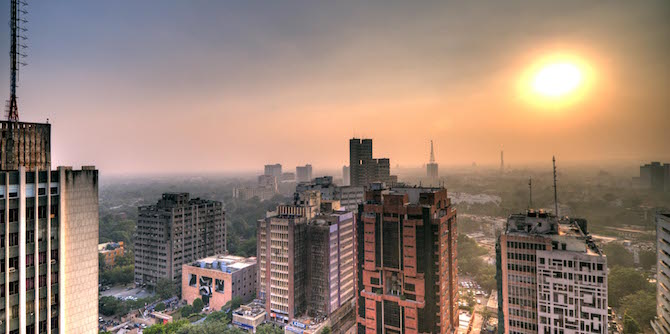
Representative image: Delhi skyline under smog.
Delhi woke up on Monday morning to a thick blanket of smog, with the city's air quality slipping into the 'severe' category in the early hours after Diwali night. Data shared by the Central Pollution Control Board (CPCB) showed several monitoring stations recording an Air Quality Index (AQI) above 400, as smoke from firecrackers mixed with the capital's already polluted air.
The morning after the festival brought low visibility across large parts of the city, with areas around Inderlok among the worst affected. Commuters stepped out into a grey haze that turned the morning sun pale and left the skyline barely visible.
AQI Crosses 400 At Several Stations
The ITO station recorded 406 at around 4:20 am. Burari Crossing recorded the city's highest reading at 441, followed by Vivek Vihar at 437, Delhi Technological University at 434, and the North Campus of Delhi University and Jahangirpuri at 433 each. Rohini recorded 430, Ghazipur 418 and Mundka 417.
The city's average AQI stood at 366 at 6:30 am, in the 'very poor' category. At 7 pm on Diwali evening it was 371, and by midnight it had slipped into the severe range. Sunday's average had settled at 376, against 369 on Saturday.
According to the CPCB's classification, an AQI between 0 and 50 is 'good', 51 to 100 is 'satisfactory', 101 to 200 is 'moderate', 201 to 300 is 'poor', 301 to 400 is 'very poor', and 401 to 500 is 'severe'.
Firecrackers After The 10 PM Deadline Added To The Smoke
The sharp overnight spike has been linked to firecracker use that continued well past the Supreme Court's 10 pm curfew on Diwali night. PM2.5 remained the predominant pollutant in the capital, with firecracker emissions adding heavily to particulate matter already in the air from vehicles, dust and seasonal stubble burning.
On Diwali night itself, 20 of the city's 59 monitoring stations had already slipped into the severe category by 10 pm. The morning readings show the smoke lingered through the night instead of dispersing.
GRAP Stage III Restrictions Stay In Force
Stage III of the Graded Response Action Plan (GRAP) remains in force across Delhi-NCR. The Commission for Air Quality Management (CAQM) had invoked Stage III on Friday, three days before Diwali, as the air quality headed towards the severe range. Stage III is triggered when the AQI enters the 401 to 450 band and brings stricter curbs on construction activity and vehicle movement across the region.
What The Forecast Says Next
The Air Quality Early Warning System for Delhi has forecast that the air quality is likely to remain in the 'severe' category for the next few days, with little immediate relief expected. Morning smog and low visibility are expected to persist as temperatures dip and calm winds trap pollutants close to the ground.
In contrast, Mumbai reported air about 30 percent cleaner than last year during Diwali. For Delhi, though, the pattern is familiar — and worrying: every year the days after Diwali bring the same grey skies and the same questions about what will change before the next festival.
Delhi's air will clear only when the smoke lifts and the winds pick up. Until then, residents have been advised to limit early-morning outdoor activity, when the smog is thickest, and to keep masks handy.
Do you think the firecracker ban needs stricter enforcement next Diwali, or should the focus shift to year-round sources like vehicles and stubble burning? Tell us in the comments below.


Comments
Post a Comment